Jimmy Scoular and Cardiff City’s European adventures.

When at the top of his game in the fifties, to many, Jimmy Scoular was the type of hard-bitten Scottish footballer hewed from the toughest of rock north of the border that provided the bedrock of any successful team. He was the sort of player that would consider the likes of more modern-day ‘hard men’ of the north such as Billy Bremner, Graeme Souness or, bringing it up to date perhaps, Scott Brown, as possibly less than fully deserving of the description.
Born in Livingston, ten days after Hogmanay in 1925, he went on to become an engineer working on submarines during the Second World war, before signing as a professional football at the end of hostilities. His work in constructing things that would go into battles in distant places would serve him well when he turned his hand to club management. Continue reading →
The heirs of Chollima and the long and complicated path to the 2010 World Cup.
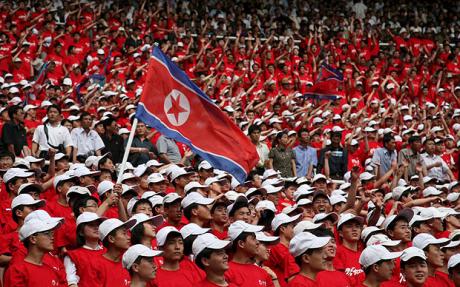
In 1966, after a qualification marked by controversy, withdrawals and political intrigue, North Korea arrived to play in the World Cup as unknown players from a land that few knew very much of. Typical of the British culture, ever keen to support the underdog though, the fans took to the ‘Chollima’ squad with their small stature and naïve innocence.
It was an approach that saw them vanquish Italy in one of the most sensational results in World Cup history and then lead Portugal by three goals to nil, before being swamped by the brilliance of Eusebio. The football observing public were charmed by these apparent innocents abroad. A brief dip into the fairy-tale of make believe that, as always seems to be the case, eventually fell short. The North Koreans left for home, leaving behind them nothing but fond memories of a team small in stature, but big in heart. Continue reading →
Jared Borgetti – Mexico’s other star striker and a lost year in Bolton.
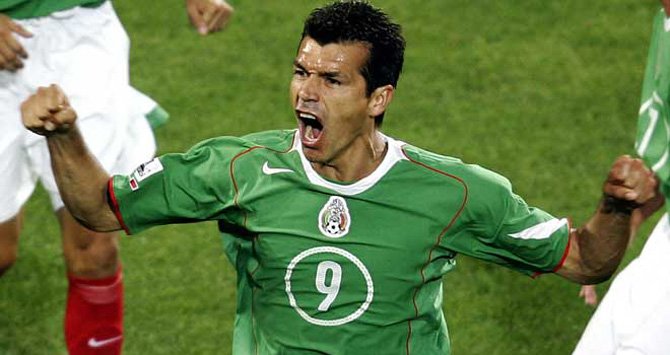
On 25th March Javier ‘Chicharito’ Hernandez scored the opening goal in a 2-0 victory for Mexico over Costa Rica. As well as giving his team an early lead, the goal also brought the Bayer Leverkusen striker’s international tally to 46, equalling the record of Jared Borgetti. Hernandez will be well known to fans of the Premier League for his five years at OId Trafford as Manchester United, under Sir Alex Ferguson dominated the English game, in the first decade of this century. Perhaps less well-known though is that Borgetti also plied his trade in the English north-west for a while, but with much less success. Continue reading →
FC Nania, Abedi ‘Pele’ Ayew and a hatful of goals.

The last day of any season can be a bit of a nail-biter, especially when there’s everything still to play for. Back at the end of the 2002-03 Scottish Premier League season, with a single game to play, Celtic and Rangers were tied on 94 points. The clubs also had a tied goal difference of plus 68. It became a last day shoot-out as to who could win their last game by the largest margin and take the title. Celtic travelled to Kilmarnock and won 4-0. At the same time however, Rangers entertained Dunfermline and secured a 6-1 victory. It was a result that also brought the title back to Ibrox by the slimmest of margins. In the end, it had come down to an injury-time penalty, coolly slotted home by Mikel Arteta to give Rangers the round half-dozen, and stymy Celtic’s effort by a single goal.
Although the two Glasgow giants rattled in a total of ten goals between them, whilst conceding a single strike, there was precious little talk of any underhand skulduggery or anything less than scrupulously contested games. After all, despite the two defeated cubs finishing the league in fourth and fifth positions respectively, Kilmarnock trailed the top two by no less forty points, and the gap to Dunfermline was over fifty points. The results therefore were not that much out of kilter, especially with the Glasgow clubs having so much to play for, and the other two teams comparatively little. A few years later, another last day battle took place between two clubs tied on points and battling for big wins to sway goal difference advantage and gain promotion to the top echelon of their domestic league structure. If the ‘Old Firm’ battle offered no hint of controversy though, this one differed on that particular count. Continue reading →
With these gloves, you can walk through mirrors.

On 20th August 2006, in a match against Cruzeiro, São Paulo goalkeeper Rogério Ceni saved a penalty. A feat worthy of mention in the context of most games of course, but perhaps not much beyond that. A few minutes later however, Ceni was called forward from his sentinel position between the sticks to take on a free-kick at the other end of the park. He scored. Now it all begins to sound a little unusual. Add on top of it that, later in the game, Ceni also took and concerted a penalty to draw his team level with their opponents and it all gets a bit special. Now, consider that the penalty was Ceni’s 64th goal for his club, surpassing by two, the exploits of legendary Paraguayan goalkeeper, José Luis Chilavert and you realise there’s more than a bit of a story relating to the career and exploits of Rogério Ceni – goalkeeper and goal-scorer. Continue reading →
Football on the small screen – The Manageress.
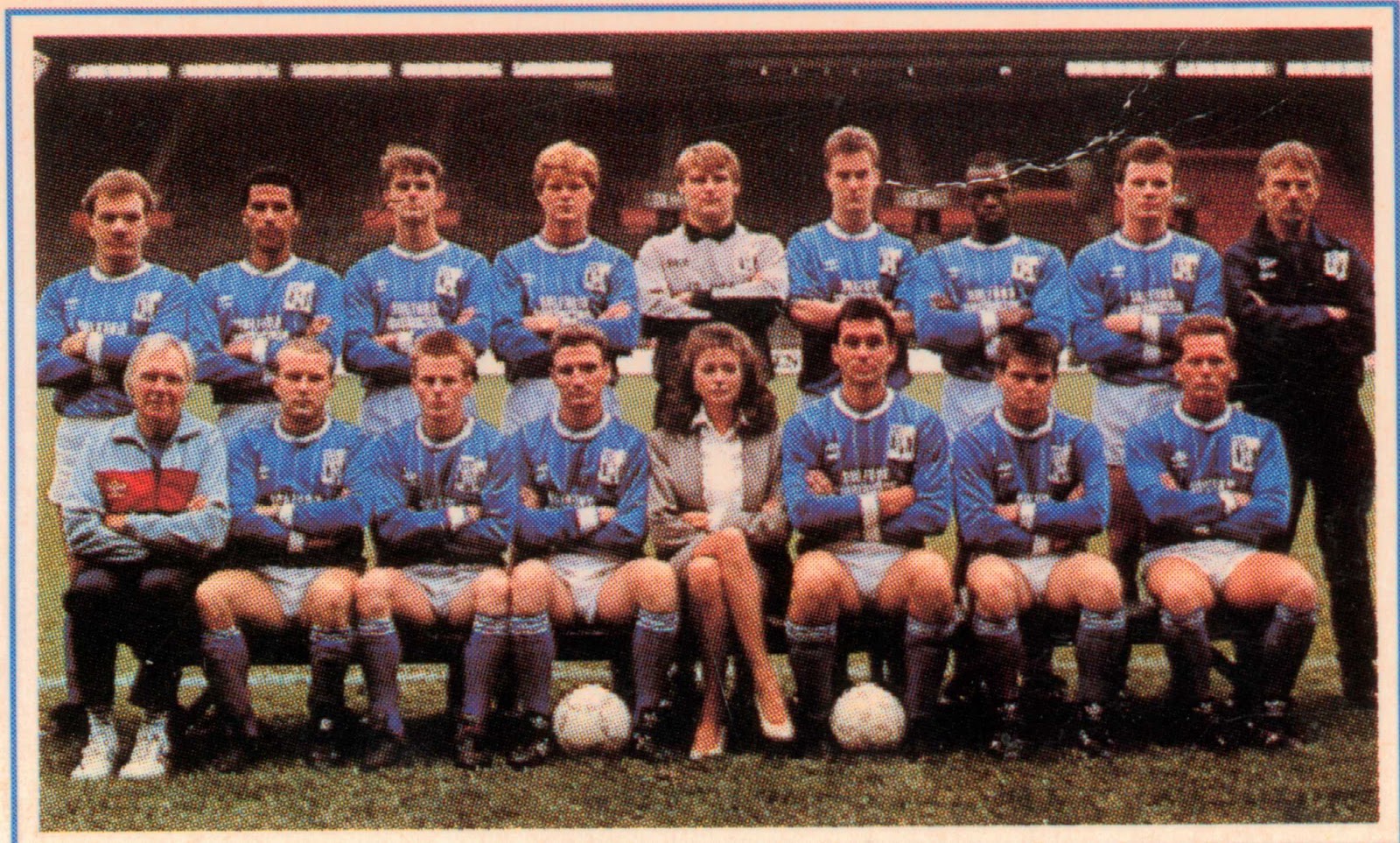
Back in 1989, a woman was in residence at number ten – the house in Downing Street that is, not the slightly withdrawn striker position – and Channel Four introduced us to the idea of female managing a professional football club. In some ways, the programme was a sign of the times, in other ways, very much less so. Continue reading →
The Never, Never Land of The Netherlands at the World Cup.

There’s a poignant inevitability about the fate of the Dutch national team in the World Cups played out in 1974 and 1978. Scornful of victory, embracing the creation and innovation rather than the denouement. Movement, flow and fluidity marked their way. Two losing finals; contrasting in so many ways, and yet so very similar in that both ultimately ended in shattering defeats by the tournament hosts. On the road, but not arriving. Bridesmaids donned in orange.
Widely touted as potential winners in 1974, but falling at the final hurdle despite having taken the lead when, perhaps an inherent arrogance surpassed their intoxicatingly tantalising skills. West Germany took advantage of the hubris and lifted the trophy. The Dutch shuffled away, not licking their wounds, but contemplating what might have been; off-shade tangerine dreamers. Continue reading →
UD Lanzarote: Volcanic roots football.
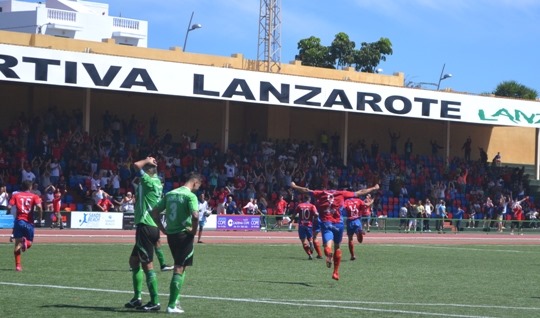
Why volcanic roots? Well, there are three reasons. The first is pretty obvious. We were on holiday in Lanzarote, and the island was born through volcanic action, so that’s one reason. Usually, the wife and I take our holidays in early June. Unless there’s a World Cup or European Championships, there’s no football to miss. This year was different however and we jetted out in September for two weeks of summer sun.
As I mentioned, usually when we’re away, there’s no football on, so nothing to miss. Of course, there’s always Sky TV’s big satellite footprint, so we weren’t bereft of news. Fortunately, there was also the prospect of taking in a local game and we discovered that Union Deportiva Lanzarote play in the fourth tier of La Liga. While we were there, they played at home against Union Viera from Gran Canaria. It’s a ‘Canaria derby.’ For a football blogger, it was just too good a chance to miss. Continue reading →
Coritiba Foot Ball Club.

Now here’s a question for all you football trivia buffs out there. Which club holds the world record for the most consecutive games won? Chelsea achieved 13 last year in winning the Premier League title, but still fell one short of Arsenal’s Premier League record of 14, but neither were anywhere near the world record total. What about Real Madrid? No. Barca? No again. Not even Bayern Munch? No afraid not. As verified by the Guinness Book of Records, the record run of wins, totalling 24, dates from February to May in 2011, and belongs to a club that you may never have even heard of.
The answer to the conundrum is the Brazilian club Coritiba Foot Ball Club. To be fair however, even to fans of the Coxa – literally translated as ‘Thigh’ – that success probably pales in significance when compared to the 1985 season, when the club won their first and, so far only, Brazilian national title. They then carried the club’s colours in the Copa Libertadores da America the following year, becoming the first club from the state of Paraná to achieve such acclaim. As the oldest club in the state, founded in 1909, that statistic is probably appropriate, but it was a long journey for the club both from its founding to 1985 and then in the run to the title as well. Continue reading →
Killing me softly – Juninho and the Middlesbrough Wonder Years.

The latter half of the 1980s was a time of great turmoil for Middlesbrough Football Club. As the 1985-86 season was drawing to a conclusion, financial matters had become so stretched that a loan of £30,000 from the Professional Footballers’ Association was the only way that the club could cover the wages for April. Unsurprisingly, the denouement of that season saw relegation, and Middlesbrough were sent down to the third tier of English football. But worse was to follow.
During the summer, with no games, and reduced revenue, the club was forced to call in the liquidators. Shortly afterwards, with padlocks adorning the rusting gates of the tired and dilapidated Ayresome Park, Middlesbrough Football Club was officially wound up. The Thatcher years had seen a decimation of industry in the region, with traditional jobs sacrificed on the altar of monetarist dogma and intransigence. Many regions suffered. The north-east suffered more than most, and the fate of the Middlesbrough’s football club seemed to be a microcosm for the travails of the 174,000 or so habitants living on south bank of the Tees. Continue reading →

