David Beckham – Redemption and glory for Goldenballs.

History likes snapshots, images frozen in time that serve as an aide memoire for a much more significant event, a more comprehensive story. The 93rd minute of the 2002 World Cup qualifying game between England and Greece played at Old Trafford on 6 October 2001 with a white-shirted England player receiving the adulation of the crowd is such a snapshot.
Seconds earlier, the ball had ripped into the Greece net, stamping England’s passport to the Finals. David Beckham, once so widely denigrated for a petulant red card against Argentina became a national hero. Redemption, as ‘Goldenballs’ is born. The player himself acknowledged the significance. “The kick was about drawing a line under four years of abuse. Four years of bitterness. Four years of England fans — not all of them, but enough to make it hurt — shouting the most horrible things at me while I was playing for my country.” That snapshot though, for all its portrayal as seminal moment has almost come to hide the immense contribution throughout the game that Beckham committed to his country’s cause, almost camouflaging the definitive captain’s performance. Continue reading →
“I looked back over my left shoulder and saw it exactly: it was not a goal.”

Unarguably, it was the most controversial goal in the biggest game in the football calendar. The ball crashed against the crossbar, bounced down and spun back into play. But did it cross the line? Two officials bereft of a common tongue consulted as players of both teams watched on, hoping not necessarily for justice but, more importantly, to be favoured by the fickle caprices of fate. Nods, gesticulations, more nods and then a blown whistle and two synchronised pointing of fingers towards the centre circle. The goal was given, England led the 1966 World Cup Final 3-2 and would notch another with time almost up, not that the late strike would detract from the controversy of the 101st minute of the Wembley showpiece, even though it carried some of its own. Continue reading →
“You don’t want to walk in another man’s footsteps, you want to create your own.” Henrik Larsson – Celtic legend.

In July 1977, the then Celtic manager, Wim Jansen pounced when Feyenoord fell into a contract dispute with their star striker. In four years with the Rotterdam-based club, he had notched 26 league goals in 101 games, but a move now seemed inevitable. Jansen convinced his board to part with £650,000 to complete the transfer, and the Hoops welcomed Henrik Larsson to Glasgow. The rest, as they say, is history. Continue reading →
Big gloves and bigger trophies – Sepp Maier, Bayern Munich and Die Mannschaft.

During the late sixties and early seventies West German football was the dominant force in the game. As well as Die Mannschaft lifting the World Cup in their homeland in 1970, Bayern Munich took three successive European Cups back to Bavaria between 1972 and 1974. A number of players featured for both Bayern and the national side, and whilst some may be more celebrated, the likes of Franz Beckenbauer and Gerd Müller spring to mind for example, few would have been more instantly recognisable than Josef-Dieter Maier, better known universally as Sepp Maier; owner of big gloves, long shorts and a goalkeeper’s cap full to the brim with medals. Continue reading →
“And where we can’t reach with our legs, we’ll reach with our hearts.” The inspiring story of Alessandro Lucarelli.

Football produces many stories. Some are sad, some are uplifting, and just a few are writ through with an impossible tale of devotion and romance that would test the credibility of any Hollywood script writer bent on wringing a few tears from his audience. The difference of course is that in football there are no tall tales, no preordained scripts, with lines rehearsed and honed to perfection, emotions delivered with cold sterility. In football there is reality. Spontaneity and reality. Drama and reality. Romance and reality. Above all, though there is reality. It’s a reality that can at times be both cruel and mundane but, at others, truly inspiring and uplifting. Some stories, football realities, you simply could not make up. This may well be one of them. Continue reading →
Beauty and the Best – Paolo Maldini and Franco Baresi.

At the heart of almost every successful team is a solid backline, usually built around the central defensive partnership. They are the bedrock of the team. They provide the foundation upon which a team is built and can grow and flourish. If the value of such partnerships is gauged by the success enjoyed by the team, then the trophies garnered by AC Milan when they dominated European football in the eighties and nineties suggest that the partnership provided by Paolo Maldini and Franco Baresi was nothing but pure gold. Continue reading →
The little big man and the big little man – Preben Elkjær and Michael Laudrup.

The ‘big man, little man’ combination is a common thread among successful striking partnerships. There’s the ‘big man,’ full of muscular hustle and bustle, aggression and a determination to dominate defenders. Then there’s the ‘little man’. He’s the smooth as silk, extravagantly skilled and elegant technician, whose ability bewitches opponents and fans alike. It’s a fairly apt description of Preben Elkjær and Michael Laudrup, Denmark’s iconic striking partnership of the mid to late 1980s when Danish Dynamite exploded into international football. Like so much about the pairing though, there’s even an iconoclastic element to the ‘big man, little man’ description. In this case, Elkjær, the ‘big man’ stood at 5’ 11”, whilst his ‘little man’ partner was 6’ 1” tall, although he hardly ever headed the ball. It’s not the only non-traditional aspect of a partnership that had so many contrasts – both on and off the field – but, particularly in the World Cup of 1986, for a brief time, took on the mantle as the most dynamic pair of strikers in world football. Continue reading →
‘Dolly & Daisy’ the rocks of Ferguson’s early Manchester United team.

If the sobriquet of ‘Dolly and Daisy’ sounds like a double act from an Old Time Musical Hall playbill, you’ll probably be surprised to learn that, thanks to their manager, it was in fact the nom de guerre of the most successful central defensive pairings of the early Premier League years. Steve Bruce and Gary Pallister were the pair in question, and they would write their names large into the history of the most successful football club of the time. It would be difficult to overestimate the importance that the pairing had on the development of Manchester United’s domestic dominance, when Sir Alex Ferguson built his dynasty of success. Suffice to say however, that the unassuming pair at the heart of the Old Trafford backline was the rock upon which the Scot relied over a seven-year partnership jammed full with trophies. Continue reading →
“Alf Ramsey was great – he even paid my fine!” – Alan Mullery the first England player to be sent off.
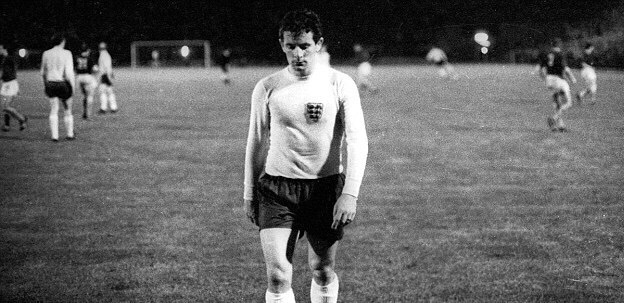
The 1968 European Championships looked very different to its modern-day equivalent. Back then, rather than the bloated jamboree involving more than 20 countries, it was very much a mini-tournament. After a protracted qualifying competition, running across a couple of years with groups and then pay-offs, a mere four teams were invited to contest two semi-finals and a final in the host country.
This particular version of the event involved Italy, who despite being hosts, still had needed to earn their place via the qualification process, England, the Soviet Union and Yugoslavia. As reigning world champions, England were favoured to do well, but at the conclusion of the event, would merely end up taking the consolation prize of third place. In relation to England however, the tournament would be remembered for a different reason, containing as it did, the first game wherein a player representing the country was sent off. That particularly unwanted distinction fell to Spurs midfielder Alan Mullery. Continue reading →
The naïve exuberance and precious, vulnerable talent of England’s Paul Gascoigne.

Millions upon millions of words have been spoken and written about the career of Paul Gascoigne; the glory and the gormless, the poetry and the prose, the joys and the tears. If one aspect of the career of Duston’s finest ever sportsman epitomises his footballing life however, it is surely the time he spent wearing his country’s national shirt. It was that most rare of occasions, when a young English footballer burst onto the world stage offering up the promise of a talent so extraordinary that it created a dream of glory, but then crashed and burnt in flames that consumed hopes and talent without mercy. There’s a phrase that’s often referred to when talk of Gascoigne and his time with England arises, so I’m going to borrow it from Gary Lineker. Let’s “have a word” about Paul Gascoigne’s time playing for England. Continue reading →
 Gary Thacker