Big gloves and bigger trophies – Sepp Maier, Bayern Munich and Die Mannschaft.

During the late sixties and early seventies West German football was the dominant force in the game. As well as Die Mannschaft lifting the World Cup in their homeland in 1970, Bayern Munich took three successive European Cups back to Bavaria between 1972 and 1974. A number of players featured for both Bayern and the national side, and whilst some may be more celebrated, the likes of Franz Beckenbauer and Gerd Müller spring to mind for example, few would have been more instantly recognisable than Josef-Dieter Maier, better known universally as Sepp Maier; owner of big gloves, long shorts and a goalkeeper’s cap full to the brim with medals. Continue reading →
Gareth and the Amazing Non-Technicolour Waistcoat – Any Dream Will Do!

On 30 July 1966, England beat West Germany to win the Jules Rimet Trophy and be crowned Champions of the World. Alf Ramsey had delivered on the pledge he made when appointed to the position of manager of the national team three years before that tumultuous day. The names of the red-shirted heroes who graced the Wembley turf on that day are etched into the memories of all England football fans. All are lauded. All are loved and, as the intervening years and an increasing number of them succumbed to the inevitable battle against mortality, so many have been mourned. In 1966, fans of the game across the country were in love with the team that represented them, and bestowed such joy upon their followers. It was a deep love, and such things last for ever. Don’t they? Continue reading →
“Ein Kampf zwischen Brüdern” – When East met West at the 1974 World Cup.
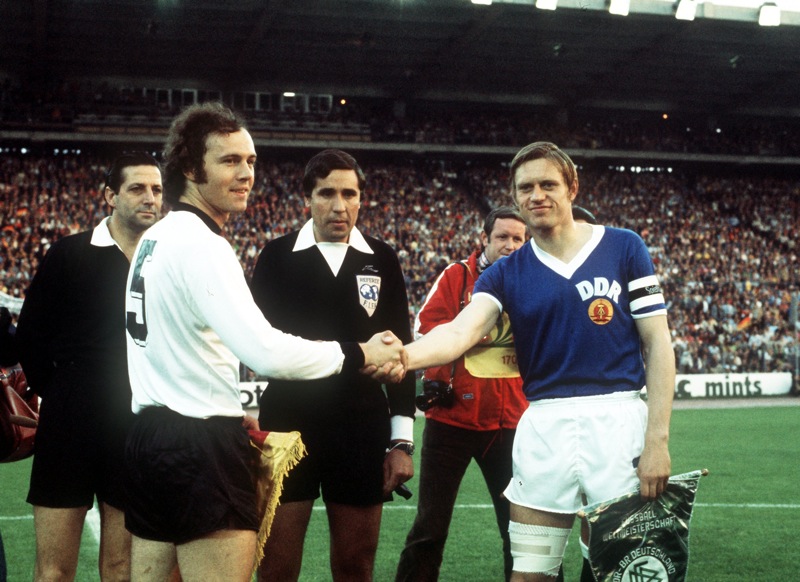
Roughly translated from German, the phrase means ‘a struggle between brothers’ and has been used to describe the game that took place as part of the initial group stages of the World Cup, when West Germany played East Germany for the only time at international level during the 41-year period when the country was divided between the capitalist west and the communist east. Continue reading →
The little big man and the big little man – Preben Elkjær and Michael Laudrup.

The ‘big man, little man’ combination is a common thread among successful striking partnerships. There’s the ‘big man,’ full of muscular hustle and bustle, aggression and a determination to dominate defenders. Then there’s the ‘little man’. He’s the smooth as silk, extravagantly skilled and elegant technician, whose ability bewitches opponents and fans alike. It’s a fairly apt description of Preben Elkjær and Michael Laudrup, Denmark’s iconic striking partnership of the mid to late 1980s when Danish Dynamite exploded into international football. Like so much about the pairing though, there’s even an iconoclastic element to the ‘big man, little man’ description. In this case, Elkjær, the ‘big man’ stood at 5’ 11”, whilst his ‘little man’ partner was 6’ 1” tall, although he hardly ever headed the ball. It’s not the only non-traditional aspect of a partnership that had so many contrasts – both on and off the field – but, particularly in the World Cup of 1986, for a brief time, took on the mantle as the most dynamic pair of strikers in world football. Continue reading →
“The secret to happiness is freedom… And the secret to freedom is courage.” (Thucydides) – The philosophy of the Libero.
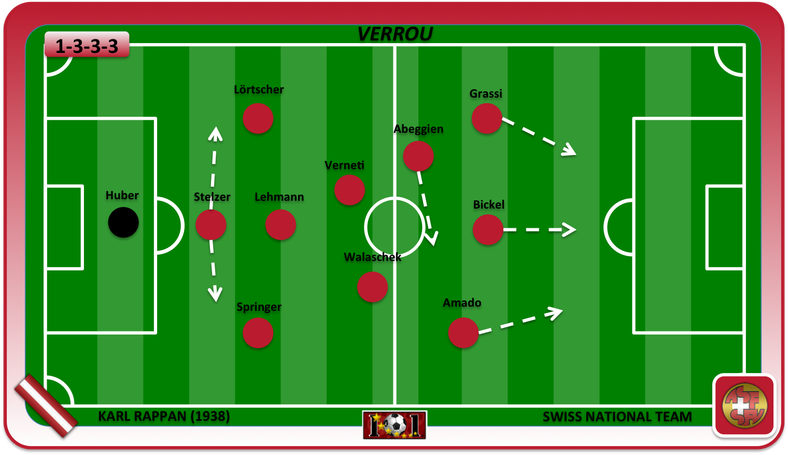
Ever since the early days of the game, wherever people have kicked a ball around, someone would come up with an idea that would help their team, their players, to be more successful and to be better achieve their aims; in short to win more often by making the most of the assets at their disposal. These sorts of ideas weren’t tactics; they surpass that. They provide the framework, the structure that tactics are hanged upon. They are ways of playing – much as there are ways of living – a set of ideas and principles that guide in decision making, a light that illuminates the path. Continue reading →
The naïve exuberance and precious, vulnerable talent of England’s Paul Gascoigne.

Millions upon millions of words have been spoken and written about the career of Paul Gascoigne; the glory and the gormless, the poetry and the prose, the joys and the tears. If one aspect of the career of Duston’s finest ever sportsman epitomises his footballing life however, it is surely the time he spent wearing his country’s national shirt. It was that most rare of occasions, when a young English footballer burst onto the world stage offering up the promise of a talent so extraordinary that it created a dream of glory, but then crashed and burnt in flames that consumed hopes and talent without mercy. There’s a phrase that’s often referred to when talk of Gascoigne and his time with England arises, so I’m going to borrow it from Gary Lineker. Let’s “have a word” about Paul Gascoigne’s time playing for England. Continue reading →
The often wise “Words of Osim.”

Ivan Osim – often popularly known as ‘Ivica Osim’ – was born in Sarajevo in 1941. The son of a Slovene-German father and Polish-Czech mother, he grew up during times of ethnic strife. Germany had invaded the then Yugoslavia just a month before his birth. It was a traumatic time that would burn deep into the mindset any young child, and it would be hugely understandable if the experience endured by the young Ivica would influence his attitude to issues in his later life. Continue reading →
Ice cold water and the scent of coffee.
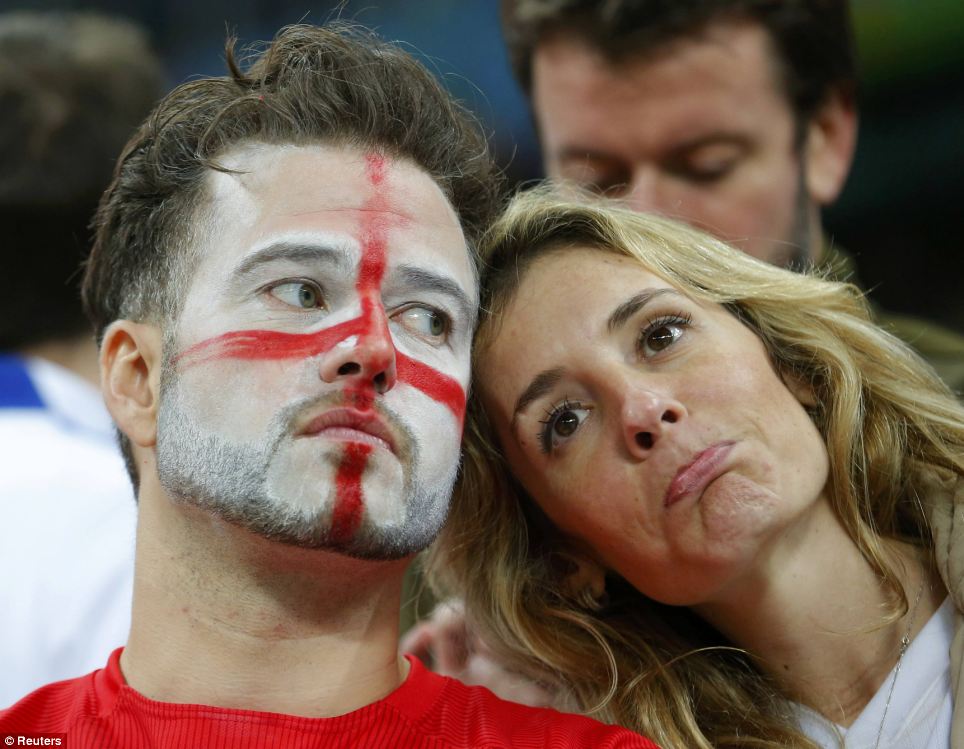
England were champions of the world in 1966, crowned on Wembley’s verdant surface. Geoff Hurst’s prile and a strike from Martin Peters were the keys to the door. Bobby Moore collected the Jules Rimet Trophy, and the world acknowledged that the Three Lions were top of the footballing tree. We all celebrated. It had taken a while to get there, but we’d shrugged off those defeats to Hungary – surely just a bad memory now. Hadn’t been afraid of Brazil. Tamed the Argentine animals, kept Eusebio in check and beat West Germany twice according to Sir Alf. No-one was going to knock us off our perch! Continue reading →
Danish Dynamite! – Denmark 6 Uruguay 1
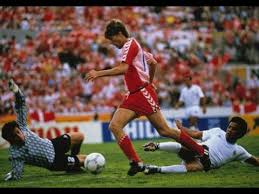
The Danish Dynamite team of the early to mid-eighties were aptly named. A collection of players that exploded into the footballing world, flaring so brightly, shaking up the established order of things, and then disappearing again all-too-soon. Lest anyone forget the impact they had though, there was a game in the 1982 World Cup when, in 90 minutes, the team in the uber-cool halved shirts offered up their ‘signature’ performance. A team at the very zenith of their powers tore their opposition asunder with a brand of football that can only be described as, well, explosive! Continue reading →
Martín Palermo – A spot (or three) of bother and more than ‘one more’ miracle.

By almost any measure you choose to evaluate a player’s worth, Martin Palermo was an exceptional striker. The Argentine played in both Spain and Argentina netting 249 goals in 592 games across a career spanning almost 19 years. Slightly worse than a goal every other game, it’s a strike rate to be proud of for someone who, for most of his career, played at the highest level. Even in his international career for La Albiceleste, at a time when his opportunities were stymied by the presence of such luminaries as Gabriel Batistuta and Hernan Crespo, he delivered a highly-creditable nine goals in 15 appearances.
For all that success though, and even taking into account the occasion when he suffered a double fracture of his left leg after a wall collapsed on him whilst celebrating a winning goal for Villareal, the thing that most football aficionados will remember about Martin Palermo is when he had a spot – or perhaps more accurately three spots – of bother in a 1999 Copa América game against Colombia. There’s more to this story than that though. Continue reading →
 Gary Thacker