Shakespeare’s lament for Arsene Wenger as Richard II.
“For God’s sake, let us sit upon the ground
And tell sad stories of the death of kings:
How some have been depos’d, some slain in war,
Some haunted by the ghosts they have depos’d,
Some poison’d by their wives, some sleeping kill’d;
All murder’d: for within the hollow crown
That rounds the mortal temples of a king
Keeps Death his court.”
(Richard II Act. 3, Sc. 2)

Let us sit on the ground and tell sad tales about the death of kings.
Shakespeare places Richard II on the Welsh coast in view of a castle for this passage. It’s a speech both moribund in meaning and shot through with pathos. A king, facing a battle he cannot win, against superior arms, with only a battle-weary army, oft-broken and of now, absent. He knows his course is run, and reflects on the inevitability of his fate. But enough now of such works of literature. What relevance do they have to the world of football? Well, perhaps more than we may think.
Bielsa leads French Revolution for Les Marseillaise.

Marcelo Bielsa
Last weekend, led by their new manager Marcelo Bielsa, Marseille defeated St Ettienne in Le Classique to go two points clear of Bordeaux at the head of Ligue 1 and a full five points in front of oil-rich PSG. After two games without a win, OM have now recorded six straight victories and look a solid contender for Le Championnat.
When Pep Guardiola was considering taking up coaching, he sought out the advice of the man he described as ‘the best manager in the world.’ A man often nicknamed ‘El Loco.’ Undertaking an 11 hour journey to South America seemed very much worthwhile however, as the two men sat and talked long into the night. The apprentice was told of the effects of the job and folklore has it that he was asked “Do you really like blood that much?” It may have seemed an extreme way of warning the younger man of what lay ahead. A few years later, after three league titles, two Champions Leagues and two World Club Cups, when a drained Guardiola exited Barcelona, he understood. The wisdom was borne out. It’s somewhat ironic then that Guardiola’s last match in charge of the Blaugrana was against Athletic Bilbao, managed by El Loco himself, Marcello Bielsa.
Dive!

Arjen Robben in the World Cup
It’s been labelled as a curse of the modern game and in post-match discussions probably causes as much controversy as any other subject, and a great deal more than most. What am I talking about? Some call it simulation. Others call it diving. For the purpose of clarity, whichever euphemism people choose to disguise it as, it is of course cheating.
You’ve all heard the managers and players justifying or bleating about it afterwards. “There was contact.” “He went down very easily” “It was soft.” “It was minimal.” There’s even my all-time favourite: “He was entitled to go down!” I’m not quite sure whether such entitlement was an inalienable right passed down from a particular deity, or just an element of the country’s constitution. I’m thinking probably neither. Continue reading →
Louis van Gaal’s 3-5-2: How the knee of a Roma midfielder shaped Manchester United’s formation for the new season.
Following Holland’s progress in the World Cup deploying the system, it was always likely that Louis van Gaal would consider bringing the 3-5-2 formation to his new club, Manchester United. That the Dutchman is a coach of world-renown, with a trail of trophies and titles behind him in countries across Europe is of course widely accepted. What may be less well appreciated however is that his adoption of the formation was less part of a strategic plan, and more a reaction to the knee injury sustained by a key player.

Louis van Gaal – 3-52 by design or necessity?
Malky Mackay and Thomas Hitzlsperger’s story

Thomas Hitzlsperger
The recent story of Malky Mackay and the infamous text messages, has reignited the way the game views matters of racism, homophobia and misogyny. It reminded me of a short article I wrote at the turn of the year about the former Premier League player and German international midfielder Thomas Hitzlsperger who had ‘come out’ as being gay. I wanted to re-post this article not because it tells of any amazing insight into the Mackay issue, but perhaps illustrates just how little attitudes within the game have changed. Continue reading →
Louis van Gaal and the Class of ’97.

Van Gaal at the Camp Nou
If you were asked to produce a list of the managers who have left a major mark on football, who would be on the list? Ferguson? Almost certainly. Wenger? Probably. Mourinho? Ancelotti? Arguably. Some may even reach back a little further in time, and pull out Rinus Michels as a name. There’s a case to be made for all of the above.
Some, such as Michels with his ‘totaal voetball’ have done so with tactical innovation. Others, such as Sir Alex Ferguson or Arsene Wenger in English football, can claim to have dominated for a while. The likes of Jose Mourinho and Carlo Ancelotti have broken barriers with winning Champions League trophies with different clubs, building winning squads again and again. Very few however could lay claim to have influenced so many future high-profile managers, in such a short period of time, as Louis van Gaal did in his spell at Barcelona between 1997 and 2000. Continue reading →
The poisoned chalice of being the man that follows the man.

With the new season just around the corner, and a new man at the helm at Old Trafford, it seemed an appropriate time to reprise an article I produced around the turn of the year talking of the difficulties that Davis Moyes was facing, and would face moving on as he sought to replace Sir Alex Ferguson. It also discussed that if Moyes was moved on, the next manager in line may have an easier ride. It turned out to be quite prescient.
La Liga Preview: Barca or Los Blancos – who will reign in Spain? – Part 2

Real Madrid manager Carlo Ancelotti
La Liga offers an intriguing prospect for the coming season as both Barcelona and Real Madrid seek to re-establish themselves at the head of the pecking order in Spain. It’s tempting, but would probably be too easy, to write off the chances of Diego Simeone piloting Atletico Madrid to a second successive title. Safe to say however that Atleti’s chances will surely have been damaged by the loss of so many players to supposedly ‘bigger’ clubs.
Los Blancos and Barca, on the other hand, have very much gone the other way, with both having strengthened their squads significantly. Last week I assessed the chances of Luis Enrique bringing the title back to Catalunya in his first season in charge at the Camp Nou. This week, I’ll be taking a look at Carlo Ancelotti‘s squad and the prospects of him making Real Madrid champions of Spain once more.
The Manageress
Time is the great enemy of the football blog writer. An issue is thrown to the front of the game’s consciousness, just crying out for a story to be penned. You go into research mode, start gathering evidence and begin to put the piece together. Get the structure right, check your references and, finally, start to write. Then, without warning, the story changes. You didn’t see that coming did you? So, you go back, reassess and consider an alternative approach. Find your angle, and then… another twist in the tail occurs. You’re faced with two choices. Throw all of your research in the bin and move on, or realise that every twist of fate, every corner uncovered enriches the story and you shouldn’t let it go.
Such has been the story of Helena Costa’s appointment as coach of French second division side Clermont Foot, and the events that followed. The switchback of a story has all the ingredients of a soap opera, and would be entertaining, were it not ultimately dispiriting in its denouement – at least to date. During the tail-end of the 1980’s Channel Four broadcast series called ‘The Manageress’ with the basic plotline of a struggling Second Division club (this was before the days of the Premier League, and the league was what is labelled as ‘The Championship’ in new money) appointing a woman as team manager. The part of Gabriella Benson was played by Cherie Lunghi, and the story told of the trials and tribulations she went through, trying to be taken seriously as a woman in a man’s world. Sound familiar?
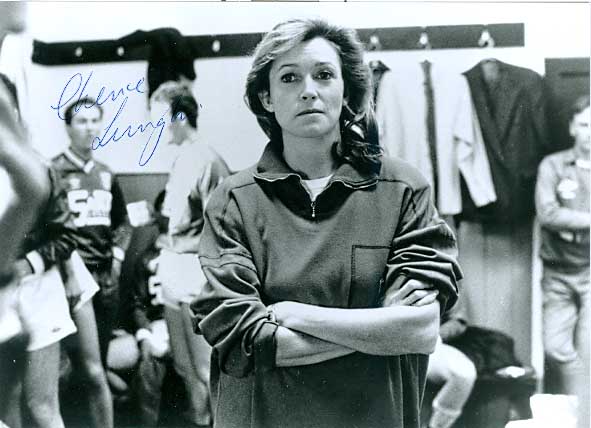
Although the series was relatively successful, with a second run shown in the summer of 1990, critics panned it as being unrealistic. 15 years or so later, I’m not so sure, at least in one sense. The subject matters it dealt, such as misogyny, relations between club and coach, agents, player behaviour and the media, have echoes in the story of Helena Costa and Clermont Foot. Continue reading →
 Gary Thacker