Jock Stein at Dunfermline and the launch of a legend.

The name of Jock Stein is lauded – and rightly so – throughout British football as one of the greatest managers of all time. Whilst manager of Celtic, he would accumulate ten Scottish league championships, eight Scottish Cups and six Scottish League Cups. He would also lead the club to unheralded glory when they lifted the European Cup in 1967, becoming the first British club to ascend to such honour.
Many years before that momentous Lisbon evening however, Jock Stein, coach to Celtic’s reserves after injury ended his playing career, would be told that he would never be promoted to the manager’s chair due to his Protestant beliefs. It was this barrier that caused him to leave the club in 1960, in pursuit of a managerial CV that would compel the cub to rethink. Five years later, he achieved that goal and returned to Celtic Park as manger to lead the club to glory. In between those times though, he would cut his teeth as manager and begin the legend of Jock Stein the manager that wold lead to European glory, at lowly Dunfermline Athletic. Continue reading →
The golden years of Sampdoria – Calcio’s ‘Hipster’ club.

On 6 September 1992, Channel Four launched its ‘Football Italia’ series relaying live Serie A games to a UK audience broadly unaware of the delights of the domestic Italian game. Experience of Italian football had been largely limited to teams competing against British clubs in European competition, but from that date, the gates to a broader appreciation of Calcio were thrown open. Any thoughts that viewers may have had that the experiment would wilt as defensively dominated football would be a turn-off were dispelled by the opening game as Sampdoria and Lazio featured in a hugely entertaining 3-3 draw.
Whoever chose that particular match-up to introduce Serie A to a potentially sceptical public had selected wisely. Lazio had just secured the services of Paul Gascoigne, although injury prevented him taking part in this game and ‘Samp’, as they were widely known, were one of the top clubs in the country. In fact, the previous season market the zenith of their powers and the end of a glorious four-year period for the Genoese club who had risen to prominence with a roster of legendary players, a coach who delivered outstanding performances from his players, and a shirt that became the byword for football hipster wear at the time. Continue reading →
Geoff Hurst – The stand-in who took Centre Stage
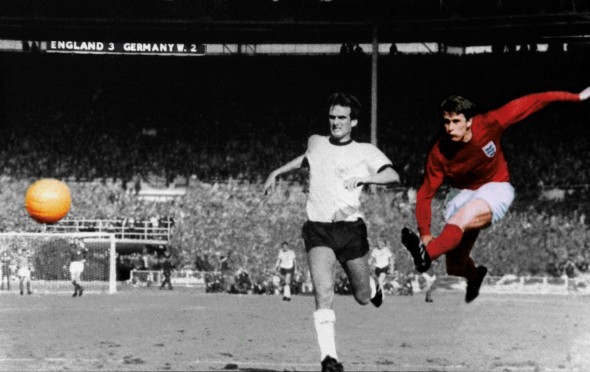
Some players go into major tournaments believing they are fated to play well, others settle for just expecting to play at all. For some however, there are tournaments where you’re selected as a squad player. The players in front of you seem well set in your position and there’s an inevitable dawning rationale that in all likelihood, you’re just there to make up the numbers. Most of the time, that’s just how it plays out. No-one remembers the players who never got on the pitch, and that seems to be your fate. Just occasionally though, the fates take a hand and the stand-in steps onto the stage to steal the show. In the 1966 World Cup, Geoff Hurst enjoyed such an experience. Continue reading →
Marta’s stellar World Cup performance and the goal that even Pelé couldn’t score.

After the game against Czechoslovakia in the group stages of the group stages of the 1970 World Cup, when he audaciously tried to chip opposing goalkeeper Viktor from the halfway line, Pelé was asked why he had attempted such an outrageous piece of skill. The most celebrated of World Cup heroes replied that he wanted a ‘signature’ goal; something that would forever be remembered as ‘the Pelé Goal’. It wasn’t hubris or extravagance, it was a search for a defining moment of his career. Continue reading →
David Beckham – Redemption and glory for Goldenballs.

History likes snapshots, images frozen in time that serve as an aide memoire for a much more significant event, a more comprehensive story. The 93rd minute of the 2002 World Cup qualifying game between England and Greece played at Old Trafford on 6 October 2001 with a white-shirted England player receiving the adulation of the crowd is such a snapshot.
Seconds earlier, the ball had ripped into the Greece net, stamping England’s passport to the Finals. David Beckham, once so widely denigrated for a petulant red card against Argentina became a national hero. Redemption, as ‘Goldenballs’ is born. The player himself acknowledged the significance. “The kick was about drawing a line under four years of abuse. Four years of bitterness. Four years of England fans — not all of them, but enough to make it hurt — shouting the most horrible things at me while I was playing for my country.” That snapshot though, for all its portrayal as seminal moment has almost come to hide the immense contribution throughout the game that Beckham committed to his country’s cause, almost camouflaging the definitive captain’s performance. Continue reading →
“I looked back over my left shoulder and saw it exactly: it was not a goal.”

Unarguably, it was the most controversial goal in the biggest game in the football calendar. The ball crashed against the crossbar, bounced down and spun back into play. But did it cross the line? Two officials bereft of a common tongue consulted as players of both teams watched on, hoping not necessarily for justice but, more importantly, to be favoured by the fickle caprices of fate. Nods, gesticulations, more nods and then a blown whistle and two synchronised pointing of fingers towards the centre circle. The goal was given, England led the 1966 World Cup Final 3-2 and would notch another with time almost up, not that the late strike would detract from the controversy of the 101st minute of the Wembley showpiece, even though it carried some of its own. Continue reading →
Guangzhou Evergrande Taobao – Chinese football’s rising dragon.

There has always been a tendency for world stars, when in the salad days of their careers, to decamp from the vigorous requirements of top-level football in Europe or South America, and migrate to less stressful leagues where financial recompense more than makes up for any apparent loss of status. Journeys to play for clubs in the Middle East or even the USA weren’t unusual. As mentioned though, the players enticed by such riches tended to be those with a mere few years left of their playing days, and willing to trade them in for a few petro-dollars, or just straightforward dollars. Continue reading →
“You don’t want to walk in another man’s footsteps, you want to create your own.” Henrik Larsson – Celtic legend.

In July 1977, the then Celtic manager, Wim Jansen pounced when Feyenoord fell into a contract dispute with their star striker. In four years with the Rotterdam-based club, he had notched 26 league goals in 101 games, but a move now seemed inevitable. Jansen convinced his board to part with £650,000 to complete the transfer, and the Hoops welcomed Henrik Larsson to Glasgow. The rest, as they say, is history. Continue reading →
Big gloves and bigger trophies – Sepp Maier, Bayern Munich and Die Mannschaft.

During the late sixties and early seventies West German football was the dominant force in the game. As well as Die Mannschaft lifting the World Cup in their homeland in 1970, Bayern Munich took three successive European Cups back to Bavaria between 1972 and 1974. A number of players featured for both Bayern and the national side, and whilst some may be more celebrated, the likes of Franz Beckenbauer and Gerd Müller spring to mind for example, few would have been more instantly recognisable than Josef-Dieter Maier, better known universally as Sepp Maier; owner of big gloves, long shorts and a goalkeeper’s cap full to the brim with medals. Continue reading →
Gareth and the Amazing Non-Technicolour Waistcoat – Any Dream Will Do!

On 30 July 1966, England beat West Germany to win the Jules Rimet Trophy and be crowned Champions of the World. Alf Ramsey had delivered on the pledge he made when appointed to the position of manager of the national team three years before that tumultuous day. The names of the red-shirted heroes who graced the Wembley turf on that day are etched into the memories of all England football fans. All are lauded. All are loved and, as the intervening years and an increasing number of them succumbed to the inevitable battle against mortality, so many have been mourned. In 1966, fans of the game across the country were in love with the team that represented them, and bestowed such joy upon their followers. It was a deep love, and such things last for ever. Don’t they? Continue reading →
 Gary Thacker