From World Cup glory to tabloid story. Lothar Matthaus: The man who fell to earth.

Back in January 2015, Lothar Matthäus, hero of the Italia ’90 World Cup victory, was embroiled in a bout of verbal sparring with Arsenal striker and compatriot Lukas Podolski. Speaking on German television, Matthaus remarked that “Lukas has his qualities; now he must prove them by bringing them back to the pitch. In the past we heard how he tweets more than he plays. He needs to concentrate on football.” The comments came during speculation regarding a potential move for Podolski to Inter Milan. It was advice that Podolski did not take too kindly to however. Apparently not content to leave it there however, Matthäus also took a swing at his former club, saying, “Inter is no longer the team of the past. Italy lost charm. Too many scandals, little modern infrastructure. In the 90s Inter and AC Milan have written the history of football, had players like Gullit, Van Basten, Hansi Müller and Karl-Heinz Rummenigge. Today the top players play in Spain, Germany and England, not in Italy.” The Nerazzuri tifosi must have loved that one. ‘A fanabla, Lothar!’ Continue reading →
“I, Big Phil, will go down in history as the Brazil coach who lost to Honduras. It’s horrible.”

So said, Luiz Felipe Scolari, as he contemplated how a defeat, so unexpected, so demoralising, so contrary to the established order of things, would surely blight his career and reputation for evermore.
Pitted against the Hondurans in the quarter-final of the Copa America of 2001, Brazil would already have been planning their semi-final strategy ahead of the game. After all, Brazil were, in most people’s eyes, the stand-out squad at the tournament. In contrast, Honduras had only been invited to join the other teams in Colombia at the last minute – in fact the last seconds of the last minute – following Argentina’s late withdrawal. Consequently, they had precious little preparation time and their squad was shorn of a number of key players still engaged in domestic matters. Last minute guests to the party, they were under-prepared, under-manned and – as it turned out to Brazil’s cost – underestimated. Just how late the Hondurans’ invite to the party popped through their letterbox can be illustrated by a brief resume of the events prior to the tournament. Continue reading →
“Pertido deal Siglo” – Blue thunder and white lightning under a hot Mexican sun.

There’s a certain type of wisdom that only comes with age and the experience; of seeing many things; by observing quietly and absorbing; by understanding. Sitting in the suburb of Santa Úrsula in Mexico City, the Estadio Azteca is not only an imposing architectural edifice, it can also boast a rich history of hosting some of the most celebrated matches in the history of international football. Being the first venue to host two World Cup Finals, it’s fair to say that the old stadium has witnessed a fair bit of the ‘beautiful game’ with some of the rarest of talents ever to grace the international arena treading its turf. When the Azteca speaks of greatness therefore, it’s done with the authority of age and experience. It’s beholding on us all to listen. Continue reading →
“Once upon a time in Argentina.” The story of Ally MacLeod and his Tartan Army.
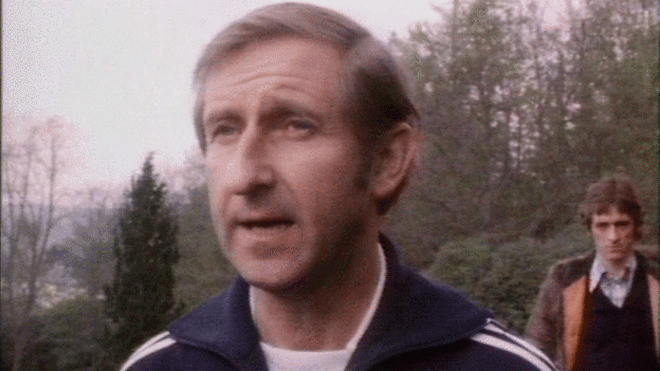
In his book ‘A matter of Life and Death: A History of Football in 100 Quotations’ The Telegraph’s columnist Jim White quotes former Scotland manager Ally MacLeod as saying, “You can mark down 25 June 1978 as the day Scottish football conquers the world.” As was later to be harshly proven, it didn’t quite turn out that way. The tale of Scotland’s venture to South America for the World Cup Finals has gone down in infamy, and if the epithet of ‘pantomime’ that many have sought to label the Tartan Army’s travails in Argentina with is appropriate, many would also be keen to cast MacLeod in the role of the piece’s villain.
Is that too harsh a judgement though? Yes, there was massive hype, and yes, there was even bigger disappointment as the whole edifice came crumbling down, but is it right that the blame for the whole sorry episode should be laid at MacLeod’s door? Was he some buffoon-like character, full of bluster and blunder, or merely an innocent abroad, a patriot wrapped up in the hopes of a nation when Scottish football was at a high-water mark, promoted ahead of his ability, for who the fates turned their faces against at the moment of truth? Continue reading →
When God was Bulgarian!
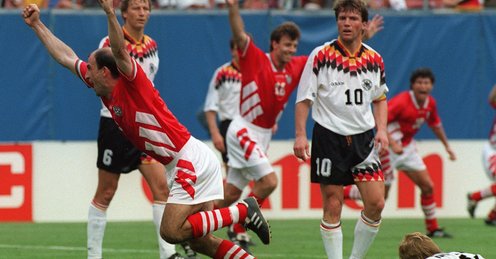
Iordan Letchkov celebrates after heading the winning goal against Germany that topped off Bulgaria’s most improbable of World Cup runs.
Football folklore is replete with tales of unfancied teams fighting back in the face of seemingly overwhelming adversity, recovering from an apparently inevitable defeat to down one of the giants of the game, when a last minute goal gets a team through a difficult match that seemed to be pointing to elimination, when the opposition fails to convert any of the first three penalties in a shoot-out or when a team comes back after losing an opening game to unexpectedly qualify from a group stage of the biggest tournament in the world. Other tales may speak of seemingly hopeless situations when unforeseen results conspire to offer a chance that had surely been extinguished, when last minute goals work wonders and unexpectedly transform successive matches, when winning goals are created and scored by players who really shoudn’t have been on the pitch or when a giant stumbles and lets the little guy through; when the most unexpected of events happen again, and again, and again. Some tales have such a feature, some have a two or three, but very few have all of them. The story of Bulgaria’s ‘American Dream’ at the 1994 World Cup and the strange combination of results and events off the park that conspired to get them there however, is one of them. Continue reading →
The man who made Benfica Champions of Europe – and then cursed them for 100 years.
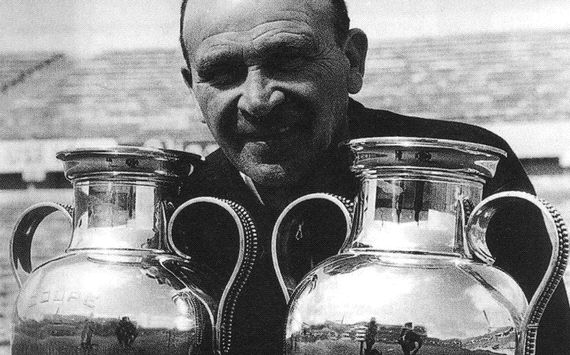
The manager who won two European Cups for Benfica, and later ‘cursed’ them not to win another for 100 years.
In sport, especially within the often wildly unpredictable world of football, there is rarely anything like a guaranteed winning bet. The Europa League Final on 14th May 2014 was however, probably as close to being a ‘dead cert’ as almost anything ever is when the ‘beautiful game’ is involved. Bet on Sevilla to beat Benfica and lift the trophy, was the call. It’s as close to being brass in the bank as any bet can ever be. Honestly! Would I lie to you? On paper it appeared to be a close contest. Both clubs had enjoyed a reasonably successful season, and had deservedly reached the showpiece final in Turin. That was as may be, but it didn’t mean backing Sevilla wasn’t a good money shot. Continue reading →
Franco Baresi – “That’s exactly it. He was special.”

Franco Baresi – Hero of the Milam tifosi and perhaps the best defender ever to grace the beautiful game.
Describing the defender that he had played alongside for so many glorious years in the Rossoneri, backline, Paolo Maldini, in an interview with Jamie Carragher said: “That’s exactly it. He was special.” In that simple phrase, he encapsulated the aura and majesty of a player who graced the famous red and black as a ‘one club’ player. A hero of the tifosi on the Curva Sud at the Stadio Guiseppe Meazza San Siro in the Lombardian city of Milan and the man for whom AC Milan retired the number six shirt; the incomparable Franco Baresi. Continue reading →
“In football, unlike bullfighting, there is no death. In football no one dies; no one gets killed.” The tragic story of Andres Escobar.

Andres Escobar – Colombia’s ‘El Caballero del Futbol’ (the Gentleman of Football)
Nacional Medellin defender and Colombia international Andres Escobar Saldariaga was once asked by Gonzalo Medina, a compatriot and journalist why he liked football. In an answer that proved to be chillingly inaccurate, the articulate Escobar replied that, “This sport illustrates the close relationship between life and the game. In football, unlike bullfighting, there is no death. In football no one dies; no one gets killed. It’s more about the fun of it, about enjoying.”
On 23rd June 1994, during the World Cup tournament in the USA, Escobar was playing for the highly-fancied Colombians against the hosts in their second group game. Following a qualifying tournament of 26 matches wherein they had been beaten on only a single occasion, culminating in a glorious 5-0 victory against Argentina in Buenos Aires, Francisco Maturana’s squad had even been tipped by the great Pele as genuine contenders to win the tournament. After losing their initial encounter to a Gheorghe Hagi-inspired Romania, the South Americans were strongly fancied to win and get their campaign back on track. Continue reading →
Brass or silver? Take your pick!
Blogs, on most subjects, tend to be full of the writer espousing his theories on the issues of the day, and I guess that’s particularly true with football articles, where everyone has an opinion. So, this time, I thought I’d take a different track and ask a few questions instead, whilst at the same time requesting a few changes of headgear!
Firstly, here’s a question with a complicated, or perhaps more accurately, a diverse set of answers. ‘What’s more important to a football club, money or glory, profits or pots, brass or silverware?’ If you’re reading this – and I hope you are, otherwise I’m simply talking to myself – you’re probably a fan of a particular club and will have opted for the latter of the options in each of the three queries offered. Now however, just for a lark, take off your fan’s hat, and instead don the headgear of a club owner, or a CEO having to answer to an owner. To further illustrate the picture, let’s imagine the owner in question isn’t a Sheikh Mansoor or Roman Abramovich who bought clubs merely to indulge rather expensive hobbies. So, with your new hat on, let’s consider the question again. I know what you’re thinking. Winning trophies creates more wealth, therefore you can have both. Ah, you see, this is why I framed the question as I did. For clarity however, I’m going to rephrase it slightly. As an owner or a CEO having to report to an owner, would you rather have made £3million profit and won the Carling Cup, or £8million, and finished with an empty trophy cabinet? Come on, now. We all know the answer if we’re being honest don’t we?

Is money rather than glory the aspiration of the modern football club?
Farewell to Juan Roman Riquelme: Rebel with a pause.

Juan Roman Riquelme had his own philosophy about football.
Around nine years ago or so, I was on holiday in Sitges, just outside Barcelona. As is my wont at such times, I was sitting outside a bar with a cold beer whilst the wife had gone off shopping. Relaxing in the Catalan sunshine, I was reading – well reading may be too strong a word, but my fractured Spanish just allows me to understand every third word or so, so I can grasp the essence of the story – a copy of ‘Sport’, a local newspaper that covers football, and predominantly FC Barcelona. Continue reading →
 Gary Thacker