When decisions are on the line.
Linesmen, Referees’ Assistants or simply ‘Linos’, the guys running up and down the sidelines of half of the playing area are often considered the least significant characters in the passion play that is a football match. These are the ‘extras’ that make up the lower listings in the dramatis personae.’ They’re the ‘non-speaking’ participants, who have to wave a flag – or perhaps press a buzzer as well these days – to remind the rest of us that they’re there.
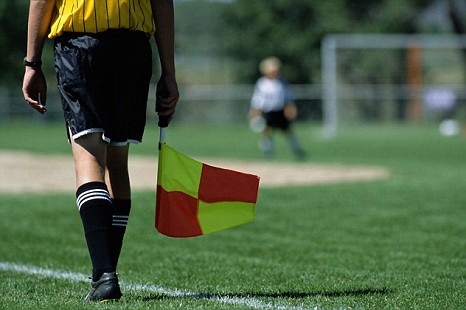
Flag at the ready. The linesman is often the least noticed participant in the football drama.
Bayern Munich, financial pressures and the power of popular politics.

As Bayern Munich are one of the top clubs in world football, mid-season tours a lucrative exercise
With the financial demands on Europe’s top clubs, there’s an ever-intensifying demand for every last pound or euro to be wrung from operations. This has led to domestic mid-winter breaks, ostensibly to avoid the worst of the seasonal weather conditions and offer a break to players and staff, to now become opportunities for lucrative mini-tours to far-flung countries to boost support and promote commercial opportunities. Such enterprises can however have a negative effect, as Bundesliga champions Bayern Munich recently discovered. Continue reading →
Much Adu about…Freddie.
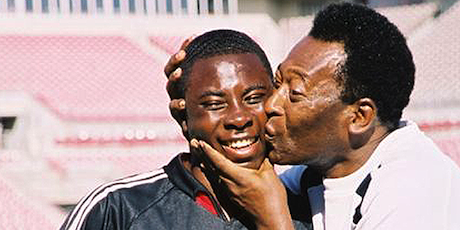
Adu with the man he was tipped to emulate.
As long as ten years ago, the World Cup in 2014 was ordained as the time Freddie Adu would prove himself to be a truly global star. Way back in 2004, the Ghanian-born American signed a professional contract with MLS club DC United at just 14 years of age. Adu had been playing against opponents twice, or even three times his age for years, drawing flattering comparisons with Brazilian legend, Pele. In the land of hype and the home of celebrity, the youngster was primed to be America’s first superstar soccer player – and 2014, when he would be 24 – was to be his coming out party. Well, that was the theory anyway. Although the USA team certainly enhanced its reputation during the Brazil tournament, Adu was not there; the ghost at his own party.
Algeria and the scandal of the 1982 World Cup.

The Algerian team in the 1982 World Cup – were they the victims of one of the game’s biggest ever stitch-ups?
When you’ve been following the ‘beautiful game’ as long as I have, you’ve seen a few World Cup tournaments. I think I remember elements of Chile 1962, but can definitely do so with the one that followed four later as England were crowned as champions of the world. The downside of this of course means that I’ve also seen some skulduggery of the lowest order in the four yearly event that should present the highest standards of the game.
The genius of Maradona was sullied when when he punched Argentina past England and then was banished as a drug cheat in the 1994 tournament. Harold Schumacher assaulted French full back Patrick Battiston with a malice that may have earned a prison sentence had it occurred anywhere but on a football pitch. And then Luis Suarez reprised his dental belligerence by biting Italian defender Giorgio Chiellini in last year’s tournament.
For conspiracy and mass inclusion however, there’s one instance that stands out, and it involved neither violence or cheating per se. No-one was banned. Indeed both of the ‘guilty’ parties progressed in the tournament, and the only injuries and damage were to broken hearts and shattered dreams. It occurred in the 1982 tournament in Spain – the very same event where Schumacher displayed an aggression well beyond the pale, but on this occasion the problem was a lack of aggression, rather than a surfeit of it. Continue reading →
Sepp Blatter and the Magna Carta.

Is it time that Sepp Blatter took a lesson from history?
It doesn’t take a Hamlet to discern that there’s something rotten in the state of Fifa. Dissension is rising over widely-perceived corruption and an autocratic ruler. President Sepp Blatter decides what will happen, and even discerns what is true and what isn’t, almost by a principle of vis et voluntas. A de facto statement that force and authority can overcome reality and justice is the very definition of a leader defined by power, with arbitrary decisions justified by the fact that he simply can. Continue reading →
Fifa spreads the good word across the silver screen. Or something like that, anyway.

Sepp blatter approved of Tim Roth’s role as the head of Fifa – I bet he did!
If you’ve heard of the film “United Passions”, you’re probably one of a fairly select few. If you’ve seen it, you’ll be part of an even smaller group. Launched at the prestigious Cannes film festival in May, it’s film with football as its central theme. Well, more or less. Actually, in fairness, a lot less.
The film was commissioned by Fifa, with an apparent desire to document “the story of Fifa’s foundation and subsequent globalisation of football” detailing the organisation’s birth and progress up until the present day. Outside of a little self-aggrandisement, it’s not easy to see what the target of the enterprise was. Safe to say, ‘Birth of a Nation’ it is not. Continue reading →
“Have a word!” Why football should reach out a hand to Paul Gascoigne
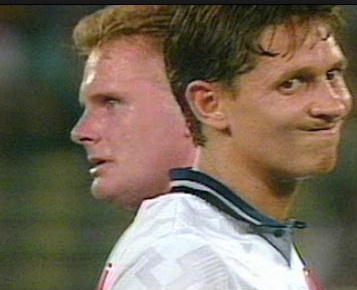
The eyes have it! Lineker asking sir Bobby Robson to “have a word” as Gascoigne receives the yellow card,
You didn’t need to be a lip-reader to understand the mouthed words. It was a typically overenthusiastic tackle, not malicious but, in fairness, it probably warranted a yellow card. Thomas Berthold certainly didn’t help matters, and why would he? Rolling around on the ground was very much de rigueur during Italia ’90 when a foul had been committed. The Brazilian referee with the English surname, Jose Roberto Wright, brandished the card and, knowing he wouldn’t play in the World Cup Final if England got there, Paul Gascoigne began to cry. Skipper Gary Lineker looked to the side-line at manager Sir Bobby Robson, or plain Bobby as he was then, and nodding at his tearful teammate asked his manager to, “have a word.”
Wind the clock forward two dozen years, and that same Paul Gascoigne is probably past tears now, having probably shed a million or so in the intervening years. His life, once so full of promise, has turned into the sort of tragic story that seems destined to end in the most tragic way. I’ve seen various opinions of Gascoigne as a player in his pomp. Some have said he was ordinary and over-rated, and of course everyone is entitled to their opinion. For me however, he had that ability to run at pace with the ball at his feet and beat a player on either side, creating problems for opponents at the heart of their defence. Enough of any debate about his talents however, that isn’t really the issue now. Were he a more ordinary type of player the story would not be any less sad. The fact that he appeared so mercurial, and with what the late Sir Bobby described as a, “daft as a brush” mentality means however that Gascoigne’s dilemma is being played out in the full glare of publicity.
Louis van Gaal’s 3-5-2: How the knee of a Roma midfielder shaped Manchester United’s formation for the new season.
Following Holland’s progress in the World Cup deploying the system, it was always likely that Louis van Gaal would consider bringing the 3-5-2 formation to his new club, Manchester United. That the Dutchman is a coach of world-renown, with a trail of trophies and titles behind him in countries across Europe is of course widely accepted. What may be less well appreciated however is that his adoption of the formation was less part of a strategic plan, and more a reaction to the knee injury sustained by a key player.

Louis van Gaal – 3-52 by design or necessity?
An Englishman in Catalunya (not) watching Spain.
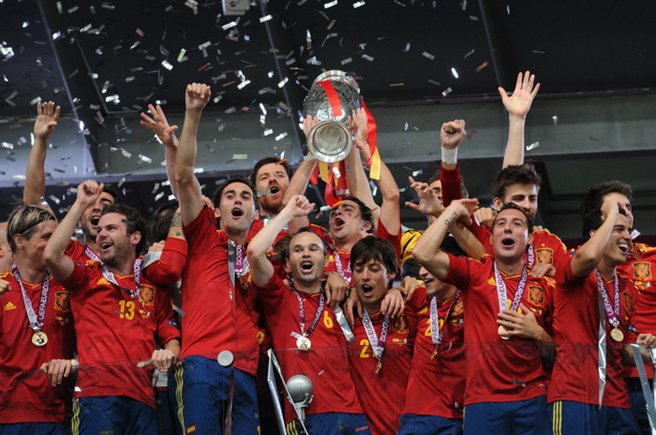
Spain winning the European Championships
A few years ago, I produced regular articles on La Liga for a website concentrating on Spanish football. I wrote this piece during a short break in Barcelona.
—
It just so happened that I was in Barcelona during the international break, so I thought it would be an opportunity to see how the Catalans, especially in this time of heightened talk of independence, viewed the Spanish national team. After all, sitting in a bar watching football, can’t be all bad, can it? That’s why the original title for this piece was “An Englishman in Catalunya watching Spain.” That was the theory, anyway.
Down and out in Rio and Brasilia.

According to the FIFA blurb, Brazil has welcomed the World Cup with arms open as wide as those of Cristo Redentor sitting atop of Sugar Loaf, and that’s probably true to some extent. When this particular carnival has packed up its tent and moved on though, what will be left for the hosts of the party?
I really wanted to call this article ‘Let Them Eat Football’ but a quick zip around the internet shows that the idea has been done to death already – curses – so I opted for ‘Down and out in Rio and Brasilia.’ After the defeat to Germany, Brazil was certainly down and most assuredly out, but it’s the aftermath of the tournament, rather than that match that I’m talking about here. Continue reading →
 Gary Thacker